




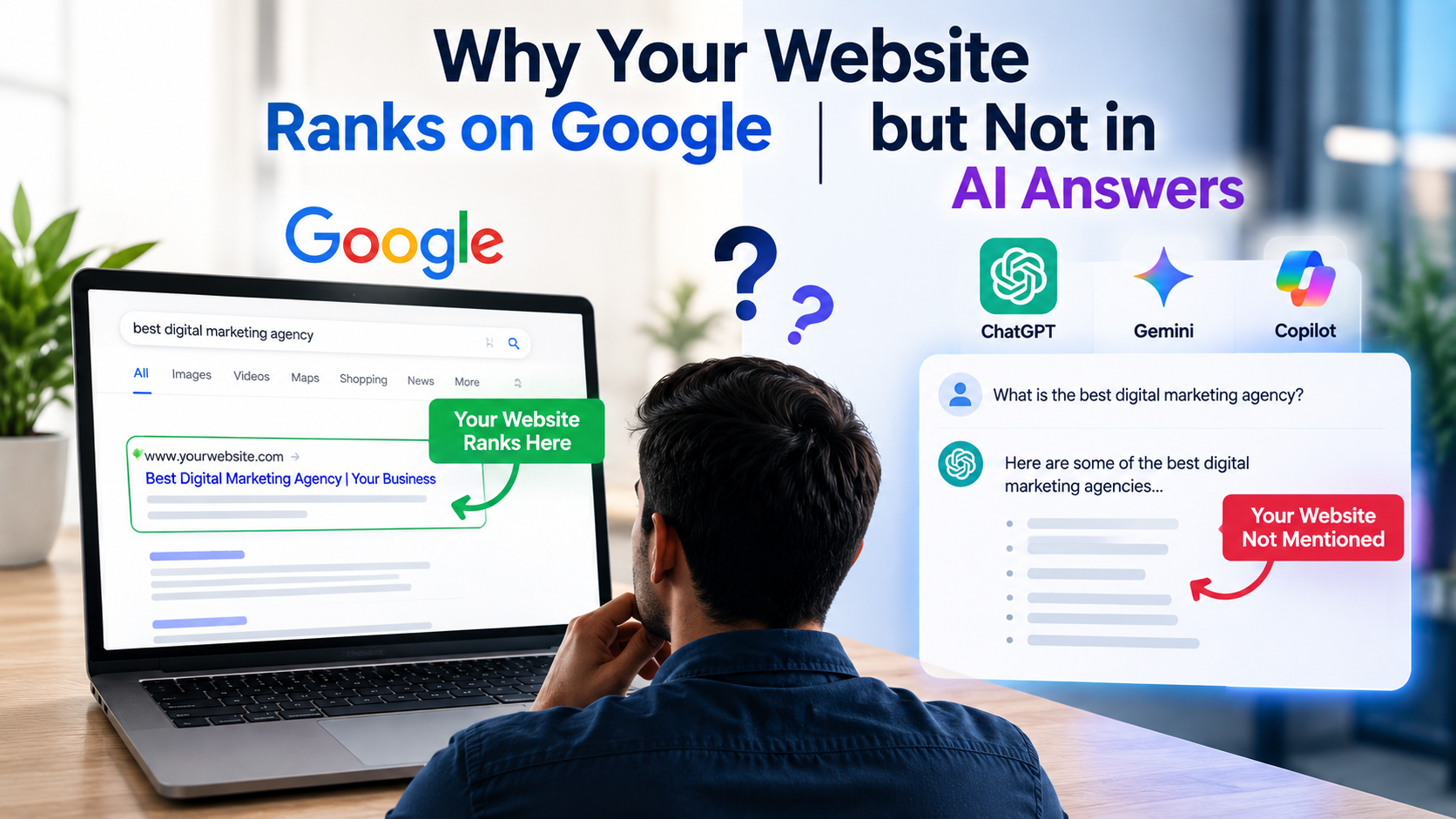
Getting your website onto the first page of Google is still an important SEO achievement. But search behavior is changing. People are increasingly asking questions directly in AI-powered search experiences and looking for summarized answers instead of browsing through several traditional search results.
This creates a common situation for businesses: your website ranks well in Google, but your brand does not appear when someone asks an AI search engine about your products or services.
Why does this happen?
The answer is that traditional search rankings and visibility in AI-generated answers are related, but they are not exactly the same thing.
Google Rankings and AI Visibility Are Different
Traditional SEO focuses heavily on helping search engines discover, understand, and rank individual pages for specific searches.
AI search experiences work differently. When generating an answer, an AI system may interpret the user's question, identify relevant information from multiple sources, and provide a summarized response.
This means ranking for a keyword does not automatically mean that your website will be selected as a source for an AI-generated answer.
For businesses, the goal is therefore becoming broader than simply ranking for individual keywords. Your website should clearly communicate who you are, what you offer, which topics you cover, and why your information is relevant.
1. Your Content May Not Directly Answer Conversational Questions
People often search Google with short phrases such as:
"SEO agency Austin"
But when using AI search, they may ask:
"What should a small business in Austin do to improve its Google visibility?"
These searches have different formats and potentially different information requirements.
If your website only targets short commercial keywords, it may not provide enough useful information for broader, conversational questions.
Consider creating content that answers the questions your potential customers actually ask before making a decision.
For example, an SEO agency could create content covering:
- How long SEO usually takes
- What a local SEO strategy includes
- How businesses can measure SEO performance
- Why a website may not be ranking
- How AI search is changing online visibility
2. Your Website May Lack Topical Depth
One article about a subject does not necessarily establish strong topical coverage.
Suppose your business provides digital marketing services and has one page about SEO. You may have a better opportunity to demonstrate expertise by creating related, useful content covering technical SEO, local SEO, content strategy, search intent, AI search, analytics, keyword research, and other relevant areas.
This creates a connected collection of information rather than isolated blog posts.
Topical authority is therefore an important concept for businesses developing content for modern search.
3. AI Systems Need Clear Business Information
AI-generated answers need to understand what a business actually does.
Make sure your website clearly explains:
- Your business name
- Services you provide
- Locations you serve
- Industries or customers you work with
- Areas of expertise
- Contact information
- Relevant credentials or experience
Avoid making important information difficult to find.
Your homepage, service pages, About page, and supporting content should communicate consistent information about your business.
4. Your Content May Be Too Generic
AI search can summarize information from many websites, so publishing another generic article that repeats information already available everywhere may not give your business much differentiation.
Instead, create content that provides something useful and specific.
You could include original examples, practical processes, first-hand experience, comparisons, data, screenshots, case studies, or detailed explanations.
For example, instead of writing only "What Is SEO?", a digital agency could explain "How We Approach SEO for a Local Service Business" and describe the actual areas that need attention.
The objective is not to write content specifically for an AI system. It is to publish genuinely useful information that can stand on its own.
5. Your Website May Have Technical SEO Problems
Technical SEO still matters.
AI visibility does not eliminate the fundamentals of search optimization. Search engines need to be able to crawl and understand your website.
Check important areas such as:
- Indexing
- Robots.txt
- XML sitemap
- Canonical tags
- Internal links
- Page speed
- Mobile usability
- Structured data
- Broken links
- Duplicate content
If important pages cannot be properly crawled or indexed, they may have limited visibility in search systems.
6. Your Brand May Have Limited Online Recognition
AI search does not only rely on one webpage.
Information about a business can exist across its website, business profiles, reputable directories, publications, social platforms, and other relevant sources.
Consistent business information across these sources can help establish a clearer online presence.
This is particularly important for local businesses. Maintaining accurate business information and building legitimate mentions from relevant sources should remain part of a broader digital marketing strategy.
7. Don't Ignore Traditional SEO
It is easy to assume that AI search means traditional SEO is no longer important.
That is not the case.
Google continues to emphasize fundamental SEO practices, while AI-powered search experiences still rely on web content and search systems to discover relevant information.
Your strategy should therefore work across both traditional and AI-driven search rather than treating them as completely separate channels.
How Brandlino Can Help Improve Search Visibility
Improving AI visibility is not about finding one secret technique or guaranteeing that a business will appear in every AI answer.
It requires a broader approach to SEO, content, technical optimization, brand visibility, and digital marketing.
At Brandlino, we can help businesses evaluate their existing website, identify content gaps, improve service pages, strengthen internal linking, develop useful content, and build a search strategy designed around how people discover information today.
The first step is understanding where your website currently appears, where it is missing, and what information may be preventing search systems from clearly understanding your business.
Final Thoughts
A strong Google ranking is valuable, but it is only one part of today's search landscape.
If your website ranks for important keywords but rarely appears in AI-generated answers, look beyond rankings. Review your content depth, technical SEO, brand information, topical coverage, and overall online presence.
The goal should not simply be to optimize for one search platform. Build a website that is easy to discover, easy to understand, genuinely useful, and supported by a consistent online presence.
That approach can help your business stay visible as search continues to evolve.